First and second mortgage lending

CD Property Mortgage

A custom build on the platform

Secured lending puts a second thing on the file: the property.

  • Collateralthe property is a record in its own right, not a note on the loan
  • No Condition 15the affordability condition covers unsecured personal loans only
  • Built for youthe largest engineering step of the range, scoped before it starts
What it is

Secured lending puts a second thing on the file: the property.

An unsecured loan has a borrower and a balance. A mortgage has a borrower, a balance, and a property whose value, title, charge and eventual discharge all have to be recorded, tracked and produced on demand.

CD Property Mortgage is built on the Covenant Desk platform with collateral as a first-class object: valuations, loan-to-value, charge registration, redemption and discharge, alongside the borrower record you already run. This is built on the Covenant Desk platform rather than switched on. It needs engineering that an unsecured personal-loan data model does not contain, so it is scoped, quoted and agreed before any work starts.

The daily screen

What your team opens every morning.

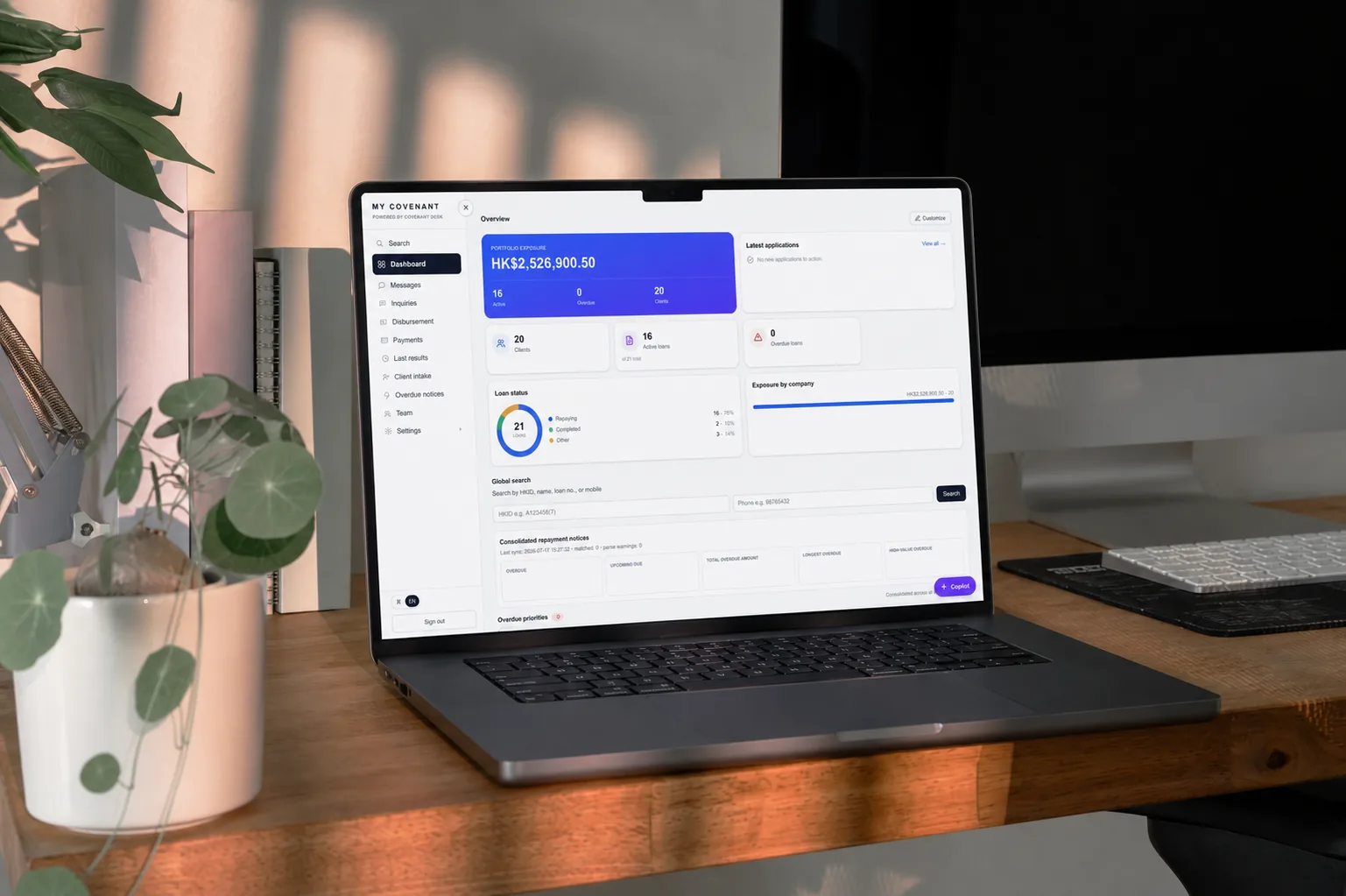
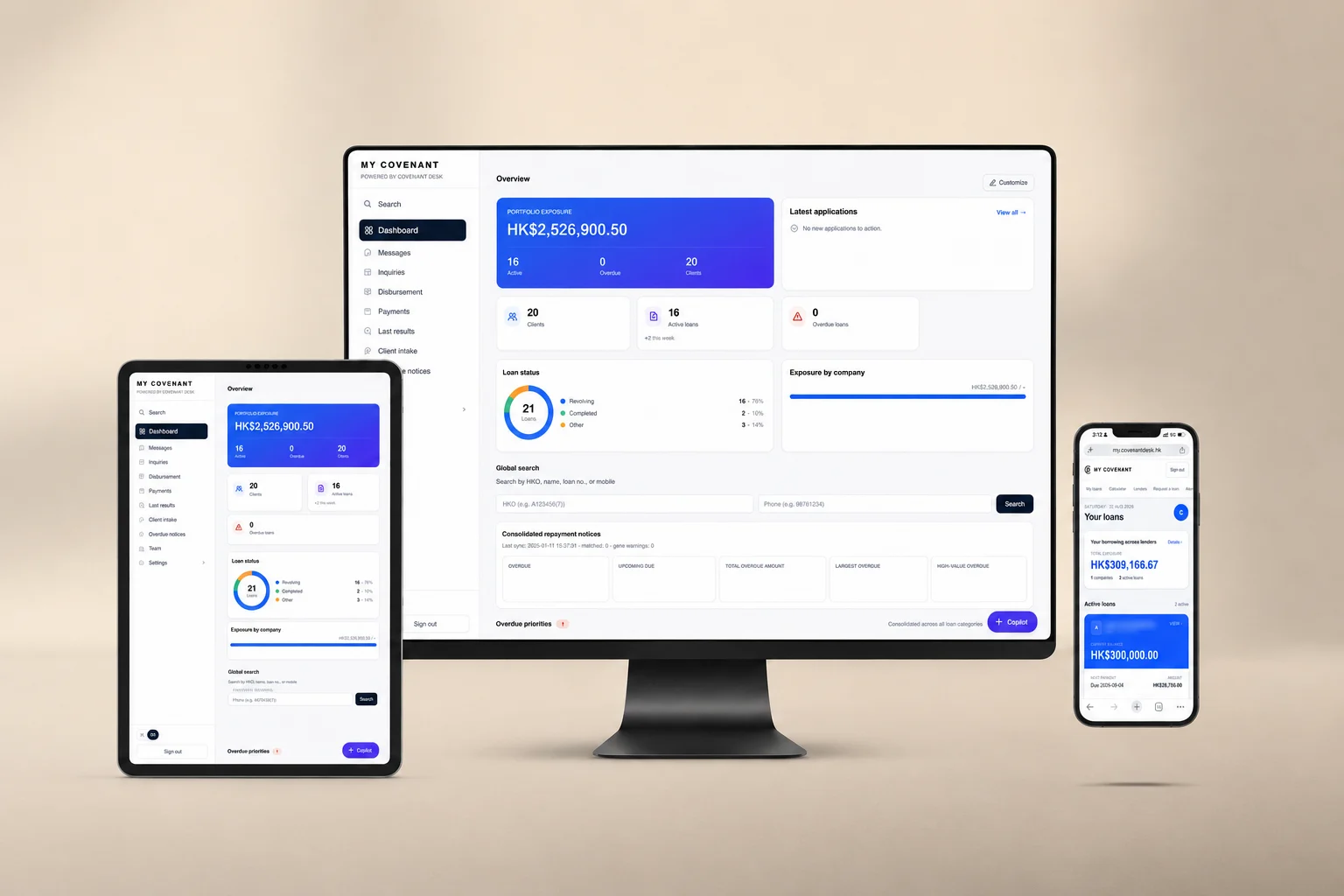
The borrower page and the property page are both real. One search reaches the borrower; the property carries its own valuations, its charges in priority order, and the discharge that eventually closes it.

  • 01The property as a record, carrying first and second charges
  • 02Valuations dated and sourced, with loan-to-value computed
  • 03Charge priority explicit rather than inferred
  • 04Bilingual English and Traditional Chinese throughout
  • 05Every sensitive lookup recorded, with phone numbers masked
CD Property Mortgage on a desktop, tablet and phone
Why lenders move

From five places to one.

01

How it usually works

  • The property is an address typed onto the loan
  • Valuations are attachments with no date the system understands
  • Loan-to-value is recalculated by hand when someone asks
  • Priority between charges is remembered, not recorded
  • A redeemed loan leaves the charge looking open

02

How it works here

  • The property is its own record with its own history
  • Valuations are dated records that visibly age
  • Loan-to-value is computed from the valuation on file
  • Priority between charges is explicit on the property
  • Redemption and discharge close as one recorded sequence
The loan, end to end

5 stages. One record.

Each stage below runs on the Covenant Desk platform. The result and the evidence behind it stay attached to the borrower and the loan.

A person looking out over Hong Kong harbour
01

The property becomes a record

Address, title particulars, tenure and existing encumbrances are held as their own object, so one property can carry a first and a second charge and the file still makes sense.

  • Address, title particulars and tenure held as their own object
  • Existing encumbrances recorded against the property
  • One property can carry a first and a second charge coherently
A phone showing a Covenant Desk borrower sign-in screen
02

Valuation drives the decision

Valuations are dated records with a source, and loan-to-value is computed from them rather than typed in. When a valuation ages, the file says so.

  • Valuations are dated records with a named source
  • Loan-to-value computed rather than typed
  • An ageing valuation is visible as ageing
Two colleagues reviewing lending data on a tablet
03

The charge is registered and tracked

Registration particulars are recorded against the property, and priority between a first and a second charge is explicit on the file rather than inferred from the order the loans were made.

  • Registration particulars recorded against the property
  • Priority between charges explicit on the file
  • A second charge is reasoned about, not guessed at
A laptop showing a Covenant Desk loan tracking screen
04

Terms are explained with the security named

Licensing Condition 5 requires the possible consequences of default to be explained, expressly including taking possession and sale of the property charged. That explanation is recorded, as the condition requires.

  • Condition 5 requires the consequences of default explained
  • Including taking possession and sale of the property charged
  • That explanation recorded, as the condition requires
A borrower making a repayment on their phone
05

Redemption and discharge close the loop

A redemption statement, the payoff, and the discharge of the charge are one sequence on the record, so a property that has been released is visibly released.

  • A redemption statement, the payoff and the discharge as one sequence
  • A released property visibly released
  • The closed file still produces intact
The AI layer, on this book too

The same assistants, reading this product’s records.

AI Copilot answers plain-language questions about your own portfolio with links back to the underlying records. AI Credit Analyst summarises a file and cites where each figure came from. Document processing reads what the borrower sent into fields your staff confirm, and email and WhatsApp intake turn enquiries into structured leads.

None of it approves anything. Every output is decision support attributed to the staff member who accepted it, and no loan is approved without a named person signing off. That boundary is the same on this product as on every other.

How the AI layer works

Where the line sits

What the software does, and what stays with you.

01

You lend, we don't

CD Property Mortgage is software. It does not provide loans, hold funds, or sign agreements on your behalf.

02

The decision is yours

Terms, approvals and credit judgements are made by your staff under your own policy.

03

We do not value or search title

No valuation, title search or Land Registry filing is performed by the platform. It records what your valuers and solicitors produce.

04

Access is recorded

Exact-HKID lookups across companies are permission-scoped and audit-logged, and phone numbers are masked.

05

Condition 15 does not reach here

The affordability licensing condition applies to unsecured personal lending only. Condition 5 is more demanding on a secured file.

06

Enforcement is not software

Possession and sale are legal processes. Nothing in the platform initiates or conducts them.

Plans and pricing

CD Property Mortgage runs on the Covenant Desk platform plans.

These are the platform plans this product line runs on. The build itself is scoped and quoted separately before any work starts, so there is no checkout button on this page — book a scoping call and we will price it against your book.

01

Starter

Start with one licensed lending company.

HK$2,000/mo HK$0 self-serve setup Includes 3 seats, 1 company, and 2,000 records
Get it scoped
03

Federation

Oversee multiple connected lending companies.

HK$14,000/mo HK$20,000 setup Includes 25 seats, 3 companies, and 20,000 records
Get it scoped
Before you book

What lenders ask about first and second mortgage lending.

Bring your own book to the demo and we will work through it against these questions rather than a slide.

Book a demo

Built for you. Collateral is a new domain object rather than a setting — valuation, loan-to-value, charge priority and discharge do not exist in an unsecured data model. It is the largest step in this range, and the demo scopes it honestly before anyone commits.

See CD Property Mortgage against your own book.

Bring the products you run, the systems you run them on, and the workflow that costs your team the most time. This is built on the Covenant Desk platform rather than switched on. It needs engineering that an unsecured personal-loan data model does not contain, so it is scoped, quoted and agreed before any work starts.