Consolidation and refinancing

CD Debt Consolidation

Runs on the platform today

The loan is the easy part. Proving the old balances are gone is the work.

  • Per creditorbalances, payoff amounts and settlement evidence held on the loan
  • One filethe new facility and every payoff it discharged, in one record
  • Condition 15affordability assessment applies — this remains unsecured personal lending
What it is

The loan is the easy part. Proving the old balances are gone is the work.

A consolidation loan is not one transaction. It is a new facility, a set of payoffs to other institutions, and a paper trail showing each prior balance was actually settled — with a borrower who is, by definition, already stretched.

CD Debt Consolidation is Covenant Desk Lending configured for payoff: creditor records on the application, settlement evidence attached to the loan, and a borrower view that shows what was cleared. This runs on Covenant Desk Lending today. It is the same borrower record and the same audit trail, configured with different products, rules and documents — a setup task rather than a build.

The daily screen

What your team opens every morning.

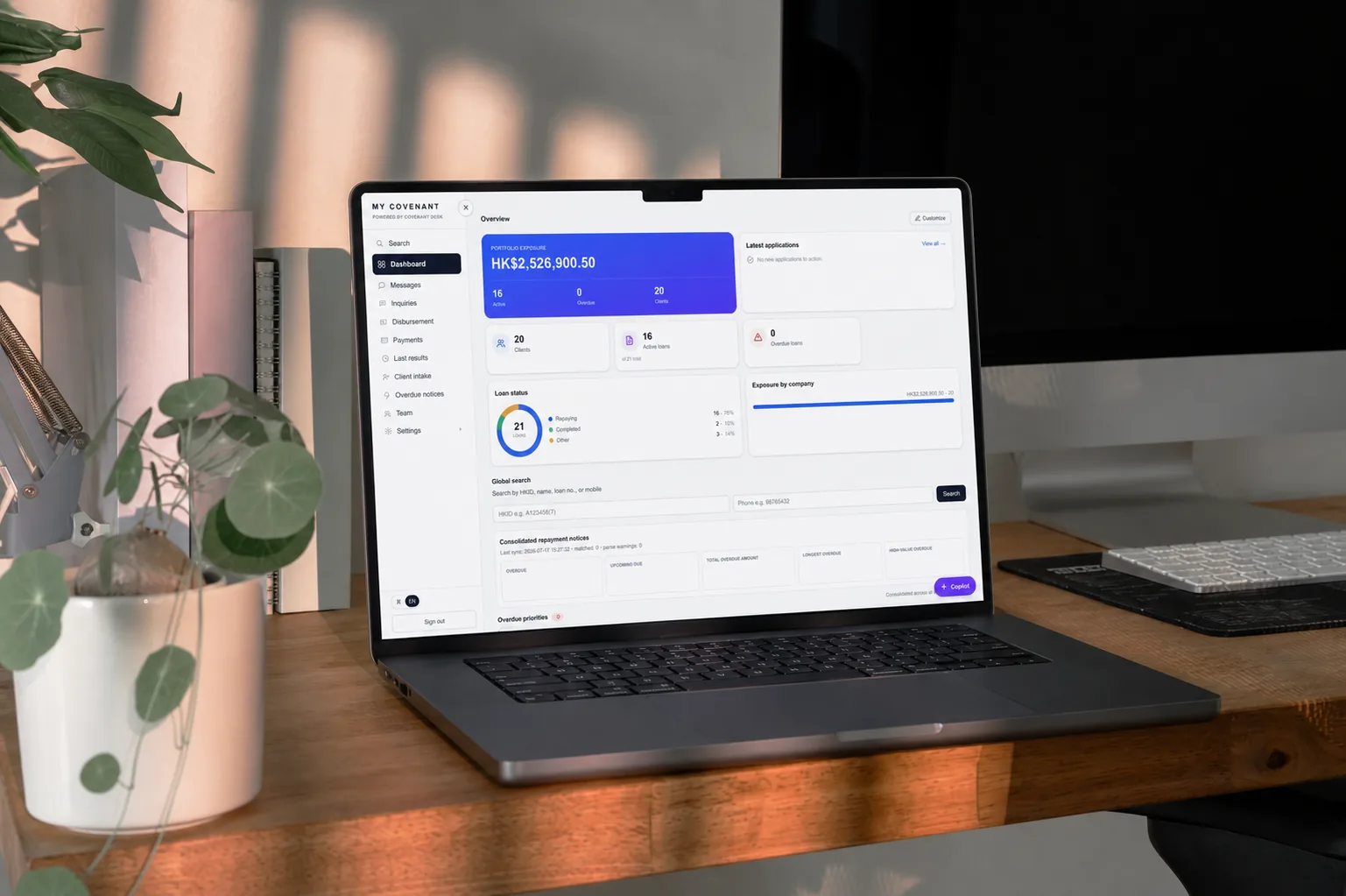
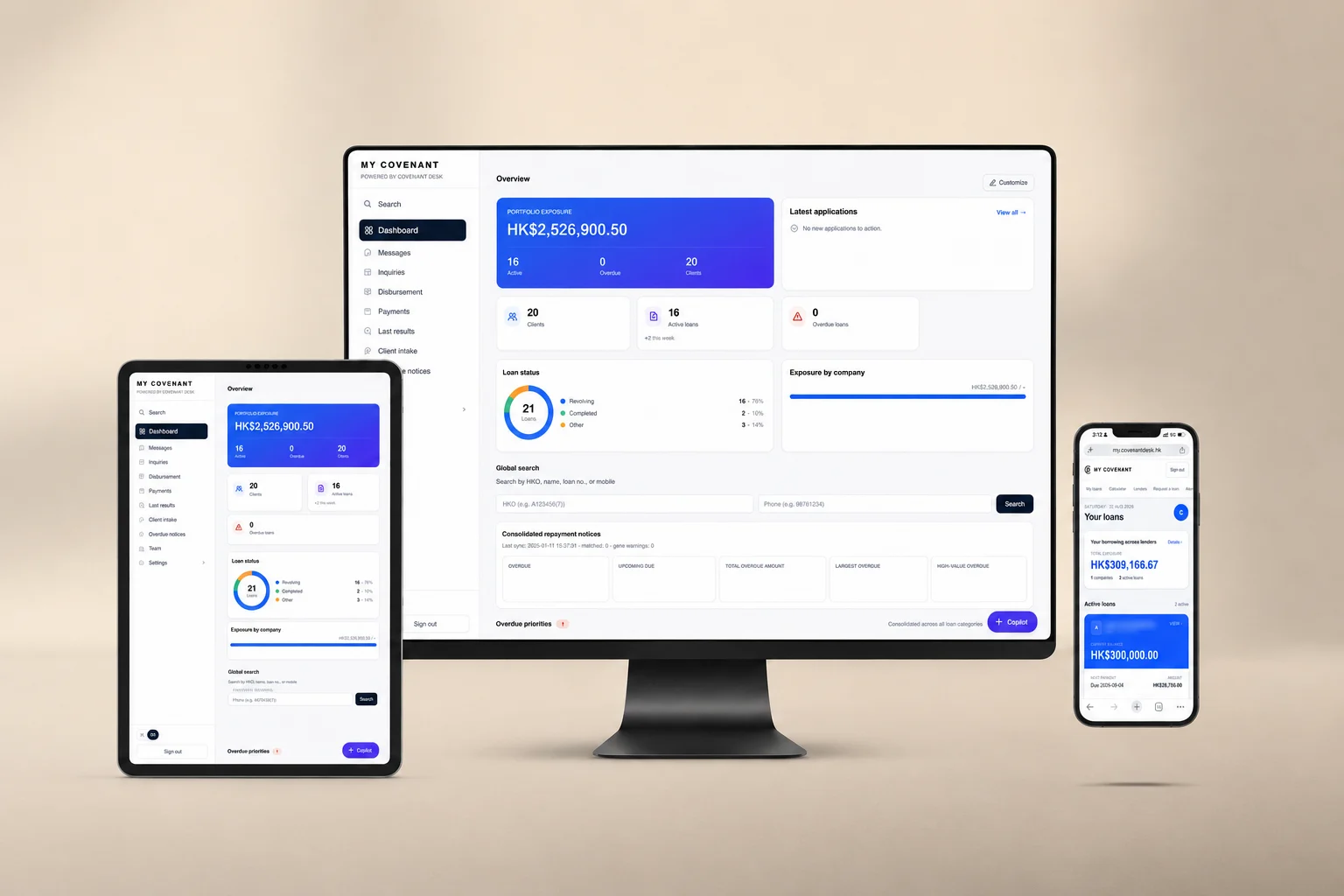
One search finds the borrower, and the page shows the whole picture: the new facility, every prior balance it was meant to discharge, the settlement evidence for each, and what the borrower now owes in one place.

  • 01Prior creditor balances as structured records, not a note
  • 02Settlement evidence attached to the loan it discharged
  • 03One consolidated schedule replacing several
  • 04Bilingual English and Traditional Chinese throughout
  • 05Every sensitive lookup recorded, with phone numbers masked
CD Debt Consolidation on a desktop, tablet and phone
Why lenders move

From five places to one.

01

How it usually works

  • The borrower's existing debts are described, not recorded
  • Payoff confirmations end up in a shared drive
  • Affordability is assessed against income alone
  • Nobody can prove later which balances were cleared
  • The borrower still gets statements from five places

02

How it works here

  • Each existing facility is a record with an institution and a balance
  • Settlement evidence files against the loan it discharged
  • Affordability is assessed against the whole commitment picture
  • The file answers what was cleared, a year later
  • One schedule, one balance, one queue
The loan, end to end

5 stages. One record.

Each stage below runs on the Covenant Desk platform. The result and the evidence behind it stay attached to the borrower and the loan.

A person looking out over Hong Kong harbour
01

The borrower lists what they owe

Existing facilities are captured on the application as structured records: institution, balance, monthly commitment. That list is what the affordability assessment is actually about.

  • Existing facilities captured as structured records
  • Institution, balance and monthly commitment on each
  • That list is what the affordability assessment is about
A phone showing a Covenant Desk borrower sign-in screen
02

Affordability is assessed against the whole picture

Condition 15 requires assessment of repayment ability without the borrower having to borrow to meet repayments. A consolidation file is exactly where that question bites, and the working stays on the record.

  • Repayment ability assessed without further borrowing
  • Current income and expenditure both considered
  • The working and its inputs stay on the record
Two colleagues reviewing lending data on a tablet
03

You approve the facility and the payoffs

The approved terms and the payoff schedule are recorded together, so what was sanctioned and what it was meant to discharge cannot drift apart.

  • Approved terms and the payoff schedule recorded together
  • What was sanctioned cannot drift from what it discharged
  • Approval authority recorded against a named user
A laptop showing a Covenant Desk loan tracking screen
04

Settlement evidence attaches to the loan

Payoff confirmations and settlement letters file against the loan they discharged, not into a shared folder. A year later, the answer to what was cleared is on the record.

  • Payoff confirmations attached to the discharged loan
  • Settlement letters stored against the record, not a folder
  • The discharge is visible on the file afterwards
A borrower making a repayment on their phone
05

One instalment replaces the others

The consolidated schedule runs like any other, with FPS references, reminders and an arrears queue. The borrower sees one balance instead of five.

  • One consolidated schedule with FPS references
  • Reminders and arrears run from the borrower record
  • The borrower sees one balance instead of five
The AI layer, on this book too

The same assistants, reading this product’s records.

AI Copilot answers plain-language questions about your own portfolio with links back to the underlying records. AI Credit Analyst summarises a file and cites where each figure came from. Document processing reads what the borrower sent into fields your staff confirm, and email and WhatsApp intake turn enquiries into structured leads.

None of it approves anything. Every output is decision support attributed to the staff member who accepted it, and no loan is approved without a named person signing off. That boundary is the same on this product as on every other.

How the AI layer works

Where the line sits

What the software does, and what stays with you.

01

You lend, we don't

CD Debt Consolidation is software. It does not provide loans, hold funds, or settle balances.

02

The decision is yours

Terms, approvals and affordability judgements are made by your staff under your own credit policy.

03

We do not contact other institutions

Payoff schedules and settlement evidence are recorded; obtaining and verifying them is your staff's work.

04

Access is recorded

Exact-HKID lookups across companies are permission-scoped and audit-logged, and phone numbers are masked.

05

This is not debt advice

The platform gives the borrower no advice about consolidating, and says nothing to them that you did not send.

06

It sits on your ledger

Existing borrower and repayment data syncs across from Softmedia or TE Credit rather than being replaced.

Plans and pricing

CD Debt Consolidation runs on the Covenant Desk platform plans.

Start from as little as HK$2,000/month. Extra staff seats are HK$1,000 one-time each; monthly pricing scales by lending companies and loan records at checkout. Configuration for this product line is done during implementation.

01

Starter

Start with one licensed lending company.

HK$2,000/mo HK$0 self-serve setup Includes 3 seats, 1 company, and 2,000 records
Buy now
03

Federation

Oversee multiple connected lending companies.

HK$14,000/mo HK$20,000 setup Includes 25 seats, 3 companies, and 20,000 records
Buy now
Before you book

What lenders ask about consolidation and refinancing.

Bring your own book to the demo and we will work through it against these questions rather than a slide.

Book a demo

No. It records the payoff schedule, holds the settlement evidence against the loan and shows the borrower what was discharged. Money moves through your own account, as it does everywhere else in the platform.

See CD Debt Consolidation against your own book.

Bring the products you run, the systems you run them on, and the workflow that costs your team the most time. This runs on Covenant Desk Lending today. It is the same borrower record and the same audit trail, configured with different products, rules and documents — a setup task rather than a build.