Guarantor and referee handling

CD Guarantor Loans

Runs on the platform today

A second person on the file means a second set of obligations.

  • Condition 13the referee's own signed written consent, captured and attached to the loan
  • Reversibleif consent was not genuinely signed, the referee's information stops being used
  • Two partiesborrower and guarantor each with their own identity, consent and audit trail
What it is

A second person on the file means a second set of obligations.

Where someone else stands behind the loan, the record has to carry them properly: who they are, what they agreed to, when they consented, and what happens if that consent turns out not to be theirs.

CD Guarantor Loans is Covenant Desk Lending configured for a second party — guarantor identity, the signed consent Licensing Condition 13 requires for referees, and a reversal path when consent fails. This runs on Covenant Desk Lending today. It is the same borrower record and the same audit trail, configured with different products, rules and documents — a setup task rather than a build.

The daily screen

What your team opens every morning.

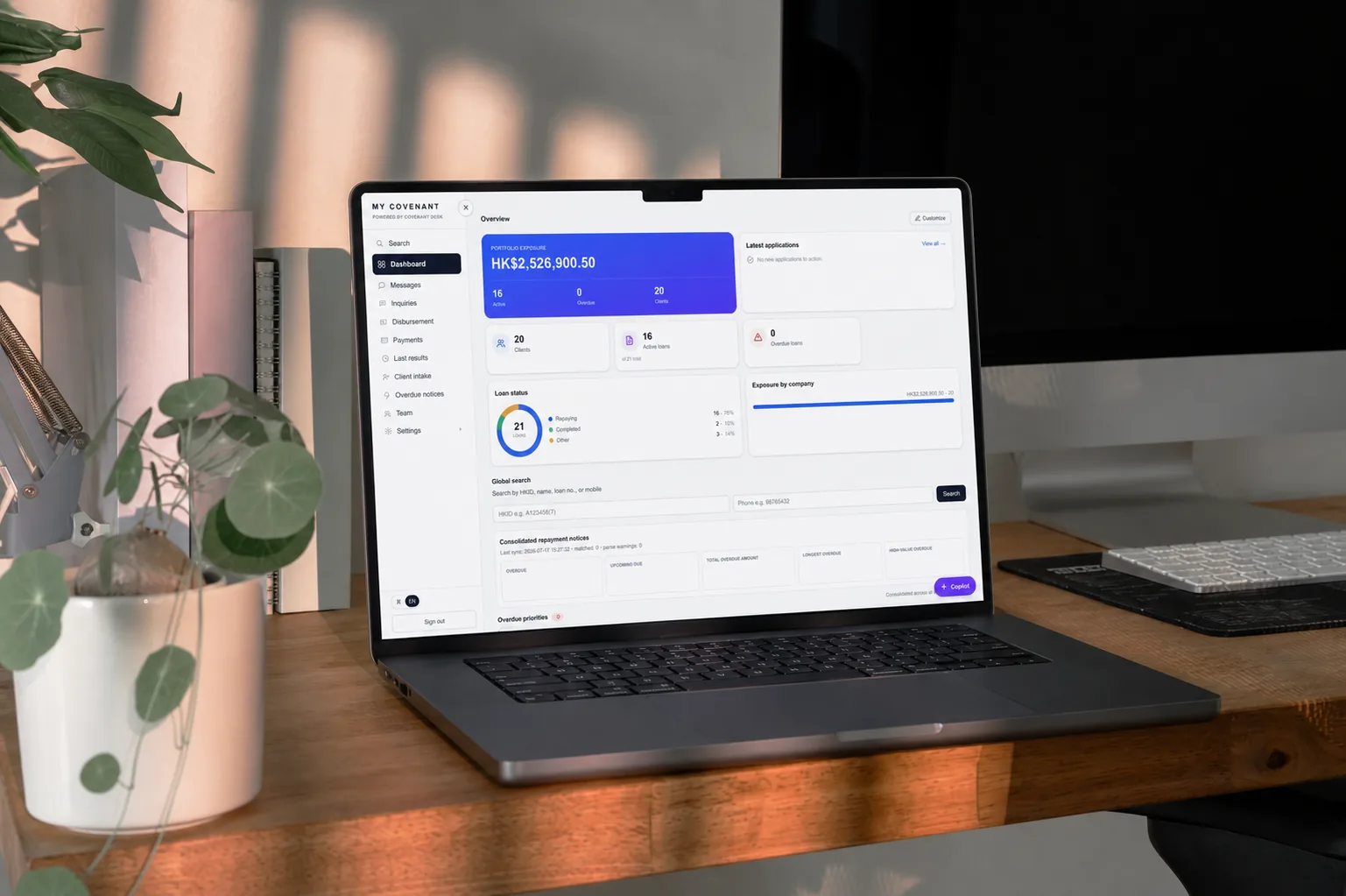
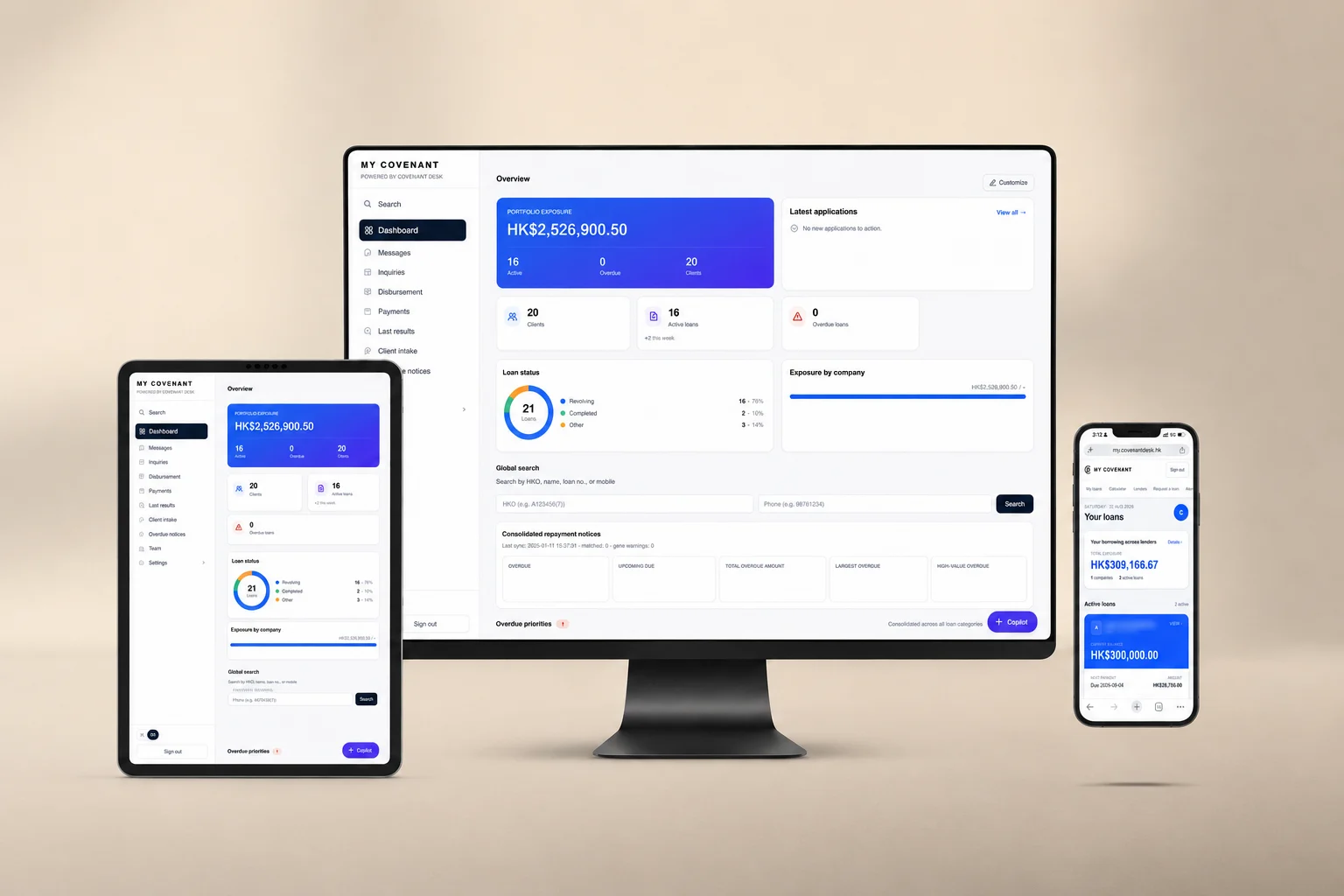
The borrower page carries the second party properly: who they are, what they signed, when they consented, and whether that consent still stands — rather than a name typed into a box on the application form.

  • 01Guarantor and referee as people on the record, with their own identity
  • 02The signed consent Condition 13 requires, attached to the loan
  • 03Third-party disclosure answered in writing on the agreement
  • 04Bilingual English and Traditional Chinese throughout
  • 05Every sensitive lookup recorded, with phone numbers masked
CD Guarantor Loans on a desktop, tablet and phone
Why lenders move

From five places to one.

01

How it usually works

  • A referee is a name and a number in a free-text field
  • Consent is assumed because the borrower supplied the details
  • Nobody can show when the referee agreed, or whether they did
  • Guarantor obligations are a note on the borrower's file
  • Withdrawing a referee's data means editing a field and hoping

02

How it works here

  • The second party is a person on the record with their own evidence
  • The referee's own signed consent is captured before use
  • The consent is attached to the loan agreement, as the condition expects
  • Guarantor obligations are their own record with their own trail
  • Ceasing to use a referee's information is a recorded action
The loan, end to end

5 stages. One record.

Each stage below runs on the Covenant Desk platform. The result and the evidence behind it stay attached to the borrower and the loan.

A person looking out over Hong Kong harbour
01

The second party is identified, not just named

A guarantor or referee is a person on the record with their own identity evidence, not a name typed into a free-text box on the borrower's form.

  • A guarantor or referee is a person, not a free-text field
  • Their own identity evidence sits on their own record
  • Their relationship to the borrower is explicit
A phone showing a Covenant Desk borrower sign-in screen
02

Consent is captured before the information is used

Licensing Condition 13 requires the referee's own written consent, signed by them, confirming they agree to act. The platform captures it and attaches it to the loan agreement, in the order the condition expects.

  • The referee's written consent obtained before the information is used
  • Signed by the referee, not by the borrower on their behalf
  • Attached to the loan agreement, in the order Condition 13 expects
Two colleagues reviewing lending data on a tablet
03

Third-party disclosure runs alongside it

Conditions 1 to 4 apply to any loan agreement: whether a third party was involved, who they are, and the prohibition on separate fee charging. Those answers sit in writing on the loan.

  • Whether a third party was involved, answered in writing
  • The third party named and their relationship recorded
  • The prohibition on separate fee charging reflected on the file
A laptop showing a Covenant Desk loan tracking screen
04

Obligations are recorded separately

What the guarantor agreed to is its own record, with its own document and its own audit trail, rather than an annotation on the borrower's file.

  • What the guarantor agreed to, as its own document
  • Its own audit trail, not an annotation on the borrower
  • Obligations visible when the loan is reviewed later
A borrower making a repayment on their phone
05

Consent can be withdrawn from the record

If you learn a consent was not genuinely signed, Condition 13 requires you to stop using that referee's information. The record is built so that is an action you can take and evidence, not a deletion you improvise.

  • A consent that was not genuinely signed can be acted on
  • The referee's information stops being used, as a recorded step
  • What was stopped, and when, is evidenced
The AI layer, on this book too

The same assistants, reading this product’s records.

AI Copilot answers plain-language questions about your own portfolio with links back to the underlying records. AI Credit Analyst summarises a file and cites where each figure came from. Document processing reads what the borrower sent into fields your staff confirm, and email and WhatsApp intake turn enquiries into structured leads.

None of it approves anything. Every output is decision support attributed to the staff member who accepted it, and no loan is approved without a named person signing off. That boundary is the same on this product as on every other.

How the AI layer works

Where the line sits

What the software does, and what stays with you.

01

You lend, we don't

CD Guarantor Loans is software. It does not provide loans, hold funds, or sign anything on your behalf.

02

The decision is yours

Whether to accept a guarantor is your credit decision under your own policy.

03

We do not verify a signature

The platform records what you captured and when. Whether a signature is genuine is your staff's judgement.

04

Access is recorded

Exact-HKID lookups across companies are permission-scoped and audit-logged, and phone numbers are masked.

05

Referees are permitted, with consent

Condition 13 requires the referee's own signed written consent, attached to the agreement — it does not prohibit referees.

06

No advice to the second party

The platform does not tell a guarantor what they are signing. That conversation is yours.

Plans and pricing

CD Guarantor Loans runs on the Covenant Desk platform plans.

Start from as little as HK$2,000/month. Extra staff seats are HK$1,000 one-time each; monthly pricing scales by lending companies and loan records at checkout. Configuration for this product line is done during implementation.

01

Starter

Start with one licensed lending company.

HK$2,000/mo HK$0 self-serve setup Includes 3 seats, 1 company, and 2,000 records
Buy now
03

Federation

Oversee multiple connected lending companies.

HK$14,000/mo HK$20,000 setup Includes 25 seats, 3 companies, and 20,000 records
Buy now
Before you book

What lenders ask about guarantor and referee handling.

Bring your own book to the demo and we will work through it against these questions rather than a slide.

Book a demo

Yes. Licensing Condition 13 permits them and sets the procedure: where a referee is provided, the lender obtains the referee's own written consent, signed by the referee, and attaches it to the loan agreement. The Registrar publishes a sample consent form. What the condition does not do is prohibit referees.

See CD Guarantor Loans against your own book.

Bring the products you run, the systems you run them on, and the workflow that costs your team the most time. This runs on Covenant Desk Lending today. It is the same borrower record and the same audit trail, configured with different products, rules and documents — a setup task rather than a build.