SME and corporate lending

CD Business Lending

A custom build on the platform

When the borrower is a company, almost every screen changes.

  • Entity firstthe borrower is a company with a BR number, not a person with an HKID
  • No Condition 15the affordability condition covers unsecured personal loans only — corporate lending sits outside it
  • Built for youan engineering engagement on the platform, scoped before it starts
What it is

When the borrower is a company, almost every screen changes.

A personal loan file is one person with one identity document. An SME file is an entity with directors, shareholders, a business registration, accounts, and guarantees from people who are themselves borrowers somewhere else.

CD Business Lending is built on the Covenant Desk platform for entity borrowers: a company as the subject of the record, directors and guarantors attached to it, and exposure measured across both. This is built on the Covenant Desk platform rather than switched on. It needs engineering that an unsecured personal-loan data model does not contain, so it is scoped, quoted and agreed before any work starts.

The daily screen

What your team opens every morning.

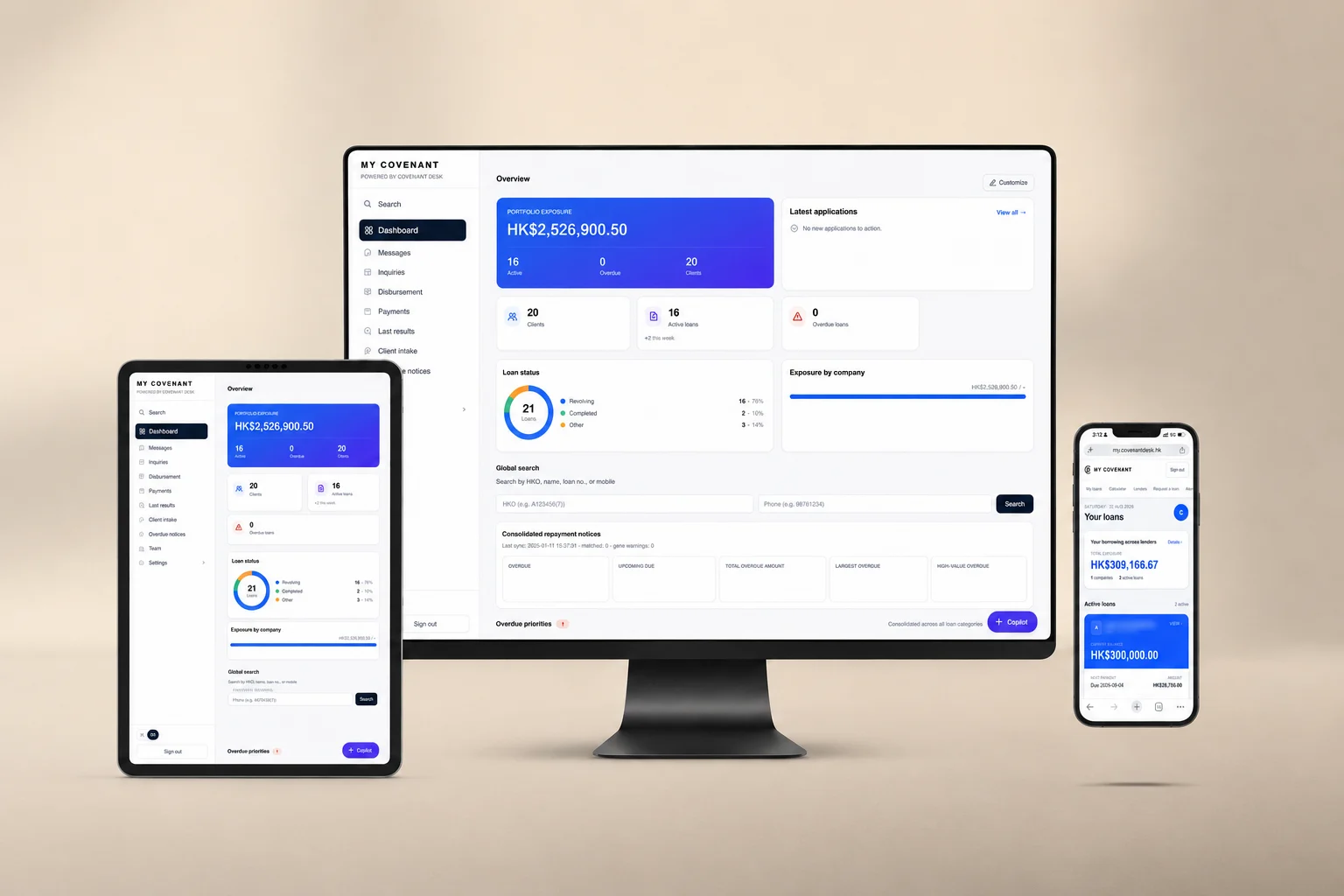
The page opens on the company, not a person: registration details, structure, the directors and guarantors attached to it, the facilities outstanding, and the exposure those people carry with you personally.

  • 01The company as the subject of the record, with its BR number
  • 02Directors and guarantors as people with their own evidence
  • 03Exposure measured across the entity and the individuals
  • 04Bilingual English and Traditional Chinese throughout
  • 05Every sensitive lookup recorded, with phone numbers masked
CD Business Lending on a desktop, tablet and phone
Why lenders move

From five places to one.

01

How it usually works

  • A company is squeezed into a record designed for a person
  • Directors live in an attachment rather than on the file
  • Screening covers whoever signed, not the entity
  • A director's personal loan and their guarantee look unrelated
  • Company documents are wherever somebody filed them

02

How it works here

  • The company is the record, with the people attached to it
  • Each director and guarantor has their own identity and consent
  • Screening runs on the entity and the individuals behind it
  • One person means one exposure, across both books
  • Documents attach to the facility they belong to
The loan, end to end

5 stages. One record.

Each stage below runs on the Covenant Desk platform. The result and the evidence behind it stay attached to the borrower and the loan.

A person looking out over Hong Kong harbour
01

The company is the record

Business registration number, company number, incorporation details and structure sit at the centre of the file, with the people attached to it rather than the other way round.

  • Business registration and company number at the centre of the file
  • Structure and incorporation details recorded, not attached
  • People hang off the company rather than the reverse
A phone showing a Covenant Desk borrower sign-in screen
02

Directors and guarantors are people on that file

Each carries their own identity evidence, their own screening result and their own consent, because each of them is a natural person with rights under the PDPO regardless of whose loan it is.

  • Each director and guarantor carries their own identity evidence
  • Their own screening result and their own consent
  • PDPO rights follow the individual regardless of whose loan it is
Two colleagues reviewing lending data on a tablet
03

Screening runs on the entity and the individuals

Sanctions and PEP screening covers the company and the people behind it. Potential matches queue for a named staff member to clear or escalate, exactly as they do on a personal file.

  • Sanctions and PEP screening on the company and its people
  • Potential matches queued for a named staff member
  • Clear or escalate decisions recorded against a user
A laptop showing a Covenant Desk loan tracking screen
04

Your credit view is whatever you configure

Turnover, accounts, sector, tenor, security — the rules and scorecards are yours to write. The platform assembles the context and routes exceptions to the authority you set.

  • Turnover, accounts, sector, tenor and security as your own rules
  • Scorecards and thresholds authored by your risk team
  • Exceptions routed to the authority you configured
A borrower making a repayment on their phone
05

Exposure is measured across the group

A director who guarantees a company facility and holds a personal loan with you is one exposure, not two unrelated files. Cross-company visibility is permission-scoped and audit-logged.

  • A guarantee and a personal loan seen as one exposure
  • Cross-company visibility permission-scoped and audit-logged
  • Group-level view for owners, company scope for staff
The AI layer, on this book too

The same assistants, reading this product’s records.

AI Copilot answers plain-language questions about your own portfolio with links back to the underlying records. AI Credit Analyst summarises a file and cites where each figure came from. Document processing reads what the borrower sent into fields your staff confirm, and email and WhatsApp intake turn enquiries into structured leads.

None of it approves anything. Every output is decision support attributed to the staff member who accepted it, and no loan is approved without a named person signing off. That boundary is the same on this product as on every other.

How the AI layer works

Where the line sits

What the software does, and what stays with you.

01

You lend, we don't

CD Business Lending is software. It does not provide loans, hold funds, or sign agreements on your behalf.

02

The decision is yours

Terms, approvals and credit judgements are made by your staff under your own policy.

03

We do not search the register

Company searches and filings are not obtained by the platform. It records what you and your advisers produce.

04

Access is recorded

Exact-HKID lookups across companies are permission-scoped and audit-logged, and phone numbers are masked.

05

Condition 15 does not reach here

The affordability licensing condition applies to unsecured personal lending only. Every other condition still applies.

06

Enforceability is a legal question

Whether a guarantee binds is for your own legal advisers, not for software.

Plans and pricing

CD Business Lending runs on the Covenant Desk platform plans.

These are the platform plans this product line runs on. The build itself is scoped and quoted separately before any work starts, so there is no checkout button on this page — book a scoping call and we will price it against your book.

01

Starter

Start with one licensed lending company.

HK$2,000/mo HK$0 self-serve setup Includes 3 seats, 1 company, and 2,000 records
Get it scoped
03

Federation

Oversee multiple connected lending companies.

HK$14,000/mo HK$20,000 setup Includes 25 seats, 3 companies, and 20,000 records
Get it scoped
Before you book

What lenders ask about sme and corporate lending.

Bring your own book to the demo and we will work through it against these questions rather than a slide.

Book a demo

Built for you. An entity borrower is not a configuration of a personal-loan record — it changes the subject of the file and therefore most screens that assume an HKID. Covenant Desk builds custom financial operations systems, and this is one of them, scoped and priced before any work starts.

See CD Business Lending against your own book.

Bring the products you run, the systems you run them on, and the workflow that costs your team the most time. This is built on the Covenant Desk platform rather than switched on. It needs engineering that an unsecured personal-loan data model does not contain, so it is scoped, quoted and agreed before any work starts.