Short-term property finance

CD Bridging Finance

A custom build on the platform

A bridge is underwritten on the exit, not on the instalments.

  • Exit-ledthe expected source of repayment is a record with a date, not an assumption
  • Days, not yearsmaturity and extension tracked as the primary state of the loan
  • Built for youshares the collateral model, so it follows CD Property Mortgage
What it is

A bridge is underwritten on the exit, not on the instalments.

Short-term property finance runs on a different clock. There is often no amortising schedule to monitor — there is a date, an expected source of repayment, and the question of what happens if that source slips.

CD Bridging Finance is built on the same collateral model as CD Property Mortgage, with the loan organised around a maturity date and a recorded exit rather than a repayment schedule. This is built on the Covenant Desk platform rather than switched on. It needs engineering that an unsecured personal-loan data model does not contain, so it is scoped, quoted and agreed before any work starts.

The daily screen

What your team opens every morning.

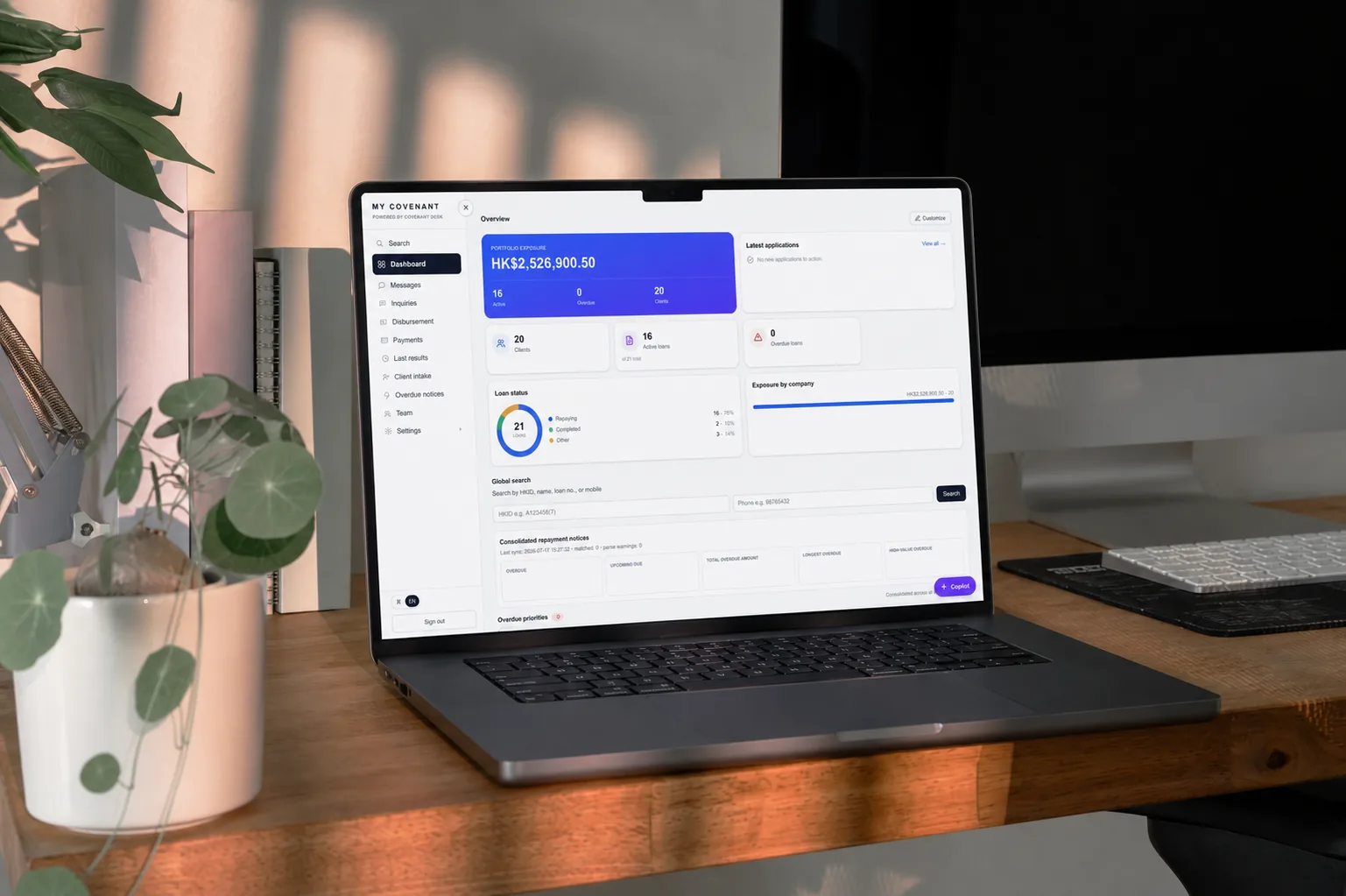
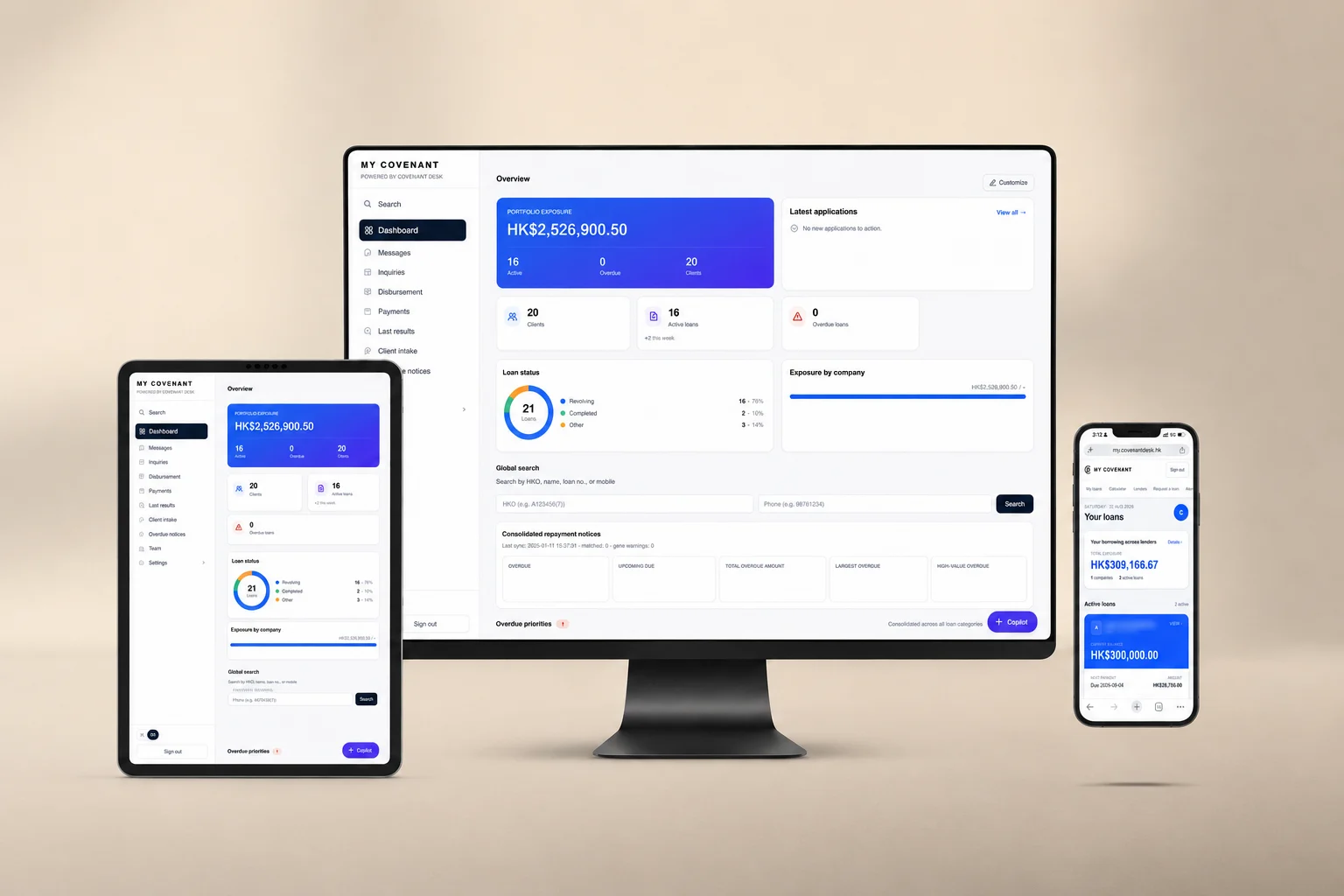
The page leads with the clock. Maturity, days remaining, the recorded exit and the extension history are the first things visible, because on a short-dated book they are what the review is actually about.

  • 01Maturity and days remaining as the loan's primary status
  • 02The expected exit recorded with its date and evidence
  • 03Extension history visible on the file, not inferred
  • 04Bilingual English and Traditional Chinese throughout
  • 05Every sensitive lookup recorded, with phone numbers masked
CD Bridging Finance on a desktop, tablet and phone
Why lenders move

From five places to one.

01

How it usually works

  • A bridge is monitored as though it had an instalment schedule
  • The exit is a conversation, not a record
  • Maturity approaches without the queue saying so
  • Interest treatment is remembered differently by different people
  • A facility on its third extension looks like a new one

02

How it works here

  • Maturity is the primary state, and the queue is ordered by it
  • The exit is recorded with a date and evidence
  • A bridge nearing its date is what you see first
  • Retained, rolled or serviced interest recorded on the loan
  • Extension history stays on the file
The loan, end to end

5 stages. One record.

Each stage below runs on the Covenant Desk platform. The result and the evidence behind it stay attached to the borrower and the loan.

A person looking out over Hong Kong harbour
01

The security is recorded first

As with a term mortgage, the property is its own record with valuation, title particulars and charge priority. On a bridge that record is doing most of the underwriting work.

  • The property is its own record with valuation and charge priority
  • On a bridge that record does most of the underwriting
  • Title particulars and encumbrances recorded, not attached
A phone showing a Covenant Desk borrower sign-in screen
02

The exit is written down

Refinance, sale or a defined receipt — the expected repayment source is captured with its date and its evidence, so the file can be reviewed against it rather than against a schedule that does not exist.

  • Refinance, sale or a defined receipt, captured as a record
  • The expected date and its evidence held on the file
  • Reviewed against the exit rather than a schedule
Two colleagues reviewing lending data on a tablet
03

The clock is the main state

Maturity, time remaining and extension history are the loan's primary status. A bridge approaching its date is the thing your queue should be showing you.

  • Maturity and time remaining as the loan's primary status
  • The queue surfaces facilities approaching their date
  • Not buried under loans with instalments
A laptop showing a Covenant Desk loan tracking screen
04

Interest treatment is explicit

Retained, rolled or serviced — how interest is handled is recorded on the loan, because on a short-dated facility it changes what the borrower actually owes at redemption.

  • Retained, rolled or serviced interest explicit on the loan
  • What the borrower owes at redemption is computable
  • No two staff reading it differently
A borrower making a repayment on their phone
05

Extension is a decision with a record

Where a bridge is extended, the new date, the reason and the authority are recorded against the loan, so a facility that has run three times shows that plainly.

  • Extension recorded with a new date, a reason and an authority
  • A facility extended three times shows that plainly
  • A book where extensions are invisible cannot be reviewed
The AI layer, on this book too

The same assistants, reading this product’s records.

AI Copilot answers plain-language questions about your own portfolio with links back to the underlying records. AI Credit Analyst summarises a file and cites where each figure came from. Document processing reads what the borrower sent into fields your staff confirm, and email and WhatsApp intake turn enquiries into structured leads.

None of it approves anything. Every output is decision support attributed to the staff member who accepted it, and no loan is approved without a named person signing off. That boundary is the same on this product as on every other.

How the AI layer works

Where the line sits

What the software does, and what stays with you.

01

You lend, we don't

CD Bridging Finance is software. It does not provide loans, hold funds, or sign agreements on your behalf.

02

The decision is yours

Whether an exit is realistic is your credit judgement, not the platform's.

03

We do not value or search title

No valuation, title search or Land Registry filing is performed by the platform.

04

Access is recorded

Exact-HKID lookups across companies are permission-scoped and audit-logged, and phone numbers are masked.

05

Condition 15 does not reach here

The affordability licensing condition applies to unsecured personal lending only.

06

Extension policy is yours

The system records extension decisions and their authority. It does not make them.

Plans and pricing

CD Bridging Finance runs on the Covenant Desk platform plans.

These are the platform plans this product line runs on. The build itself is scoped and quoted separately before any work starts, so there is no checkout button on this page — book a scoping call and we will price it against your book.

01

Starter

Start with one licensed lending company.

HK$2,000/mo HK$0 self-serve setup Includes 3 seats, 1 company, and 2,000 records
Get it scoped
03

Federation

Oversee multiple connected lending companies.

HK$14,000/mo HK$20,000 setup Includes 25 seats, 3 companies, and 20,000 records
Get it scoped
Before you book

What lenders ask about short-term property finance.

Bring your own book to the demo and we will work through it against these questions rather than a slide.

Book a demo

It shares the collateral model but inverts the monitoring. A term mortgage is watched through its instalment schedule; a bridge is watched through its maturity date and its exit. Running one as if it were the other is how extensions go unnoticed.

See CD Bridging Finance against your own book.

Bring the products you run, the systems you run them on, and the workflow that costs your team the most time. This is built on the Covenant Desk platform rather than switched on. It needs engineering that an unsecured personal-loan data model does not contain, so it is scoped, quoted and agreed before any work starts.